

LEADGL INC.About Us
WHY
Japan has things the world admires. It has a culture the world respects. It has the people and the organizations that produce them. Spread them, and the world gets better. We want more people willing to take that on. That is why we started this company.
Quality. Precision. Attention to detail. Go anywhere in the world and you will not easily find their equal. Knowing that is what makes it so disappointing that so little of what Japan can do reaches the rest of the world.
The reason is not English. How trust is built, the kind of leadership that is expected, the way a negotiation is run — all of it is carried out the Japanese way, on Japanese assumptions.
Japanese workplaces will have to change as well. Run them the Japanese way and the best people from abroad will not stay.
More Japanese people able to use everything they have, anywhere in the world. Japanese organizations rebuilt into ones that hold up globally. We do both.


We build influence that works in English.
COMPANY
Company information
| Company name | LeadGL Inc. |
|---|---|
| Founder and CEO | Toshi Iwata |
| Founded | January 22, 2024 |
| Capital | JPY 4,000,000 |
| Address | Kuwano Building 2F, 6-23-4 Jingumae, Shibuya-ku, Tokyo 150-0001, Japan |
| What we do |
English-language global leadership training for companies Global organizational development consulting English × inquiry programs for secondary schools |
| Corporate number | 2010001241755 |
| Contact us | contact form / info@leadgl.com |
MESSAGE
We build influence that works in English


Live abroad and you notice that what is ordinary in Japan is extraordinary everywhere else. The precision. The quality. The attention to detail that nobody here thinks worth mentioning. All of it comes from Japanese organizations made up of capable people. That so little of it reaches the rest of the world is something I have long found disappointing.
I spent 33 years leading research and development at three global companies. What I saw is that it is not about English. What counts is influence: setting the agenda in a meeting, holding your ground, leading the room to a decision.
What holds them back is the behavior Japan rewards — understanding the instruction precisely, building consent conversation by conversation, securing agreement in advance, then executing to plan. It is what gets you promoted here, and it works against you abroad. Leaders elsewhere do not wait for permission. They move first, show it done, and win approval that way. Whenever I wanted to steer somewhere different from everyone else, I never once got my manager’s agreement first.
People rated highly in Japan for doing everything thoroughly are sometimes not rated at all abroad. Instead, leadership matters. Alongside the ability to manage people, money and materials, you need to take a risk, step into unknown territory, and be someone people want to follow. Having both is best, and what Japan trains is mostly the first.
Trust is built differently too. Abroad, inside the company and outside it, it starts from working together until each side sees that the other is reliable. Meals and drinks come after that. In Japan it runs the other way: you build the relationship first, and the work comes out of the socializing. Since coming back I have been told by a number of people, “Iwata-san, business is born out of socializing.” Neither is better than the other. What matters is that the Japanese way does not work abroad.
English itself I was bad at. I hated it at school and applied only to university faculties where English was not on the entrance exam. In my second year of work I reorganized my schedule around 1-on-1 lessons for six months, reached the point where I could present my research and handle the questions in English, and that opened the door to a job in the United States. Talent has nothing to do with it. With the right method and real use, anyone gets there.
Japan has things the world needs, and I want people who can carry them out into the world. At the same time I want Japan to become a place that welcomes people from abroad, where anyone can do their best work. When people are connected at a personal level, the relations between countries change too. For those two things we run global leadership training for companies, and English × inquiry programs for secondary schools.
Toshi Iwata — Founder and CEO, LeadGL Inc.
MANAGEMENT
Leadership team
Our programs are designed and delivered by people who have run businesses and organizations inside global companies — and who have sat on both sides of this problem.
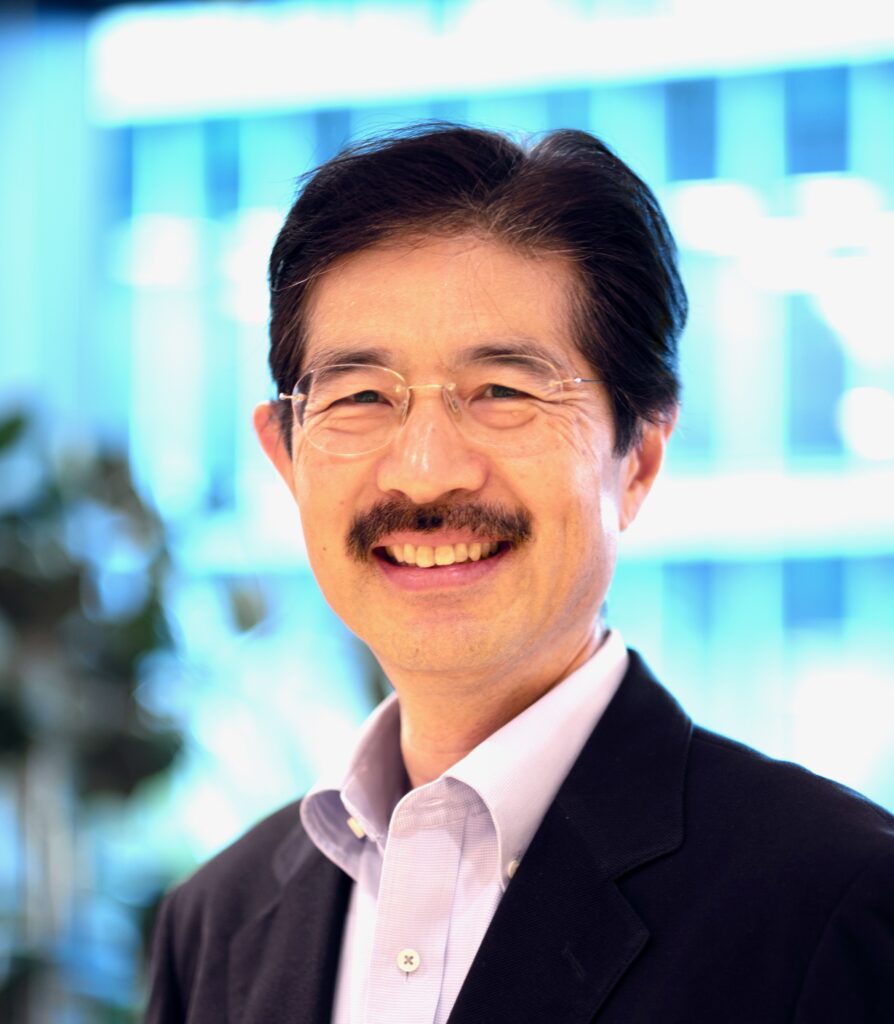
33 years at P&G, Sumitomo Dow and BASF, leading research and development organizations from small teams to large groups. Guest lecturer at the National University of Singapore. MBA (taught in English), GLOBIS University; BSc in Agricultural Chemistry, Osaka Prefecture University.

Over 20 years at Bridgestone at the center of finance, management control and business strategy, in Japan and abroad. Led restructurings, M&A, financial strategy, funding, and the build-out of FP&A. Has run organizations as CFO and general manager. MBA, GLOBIS University; BA in Economics, Keio University.

Over ten years as a university lecturer, curriculum developer, program director and teacher trainer. Has spoken at international conferences and run workshops in the United States, Japan, Korea, Cambodia, Thailand and Peru. MA in Language Teaching and Linguistics, University of Oregon; MBA, GLOBIS University.
VISION & MISSION
A future where Japanese people thrive in every corner of the world
More people choosing, for themselves, to work on the world stage
METHOD
Our method
Developing the people, and building an organization where they can perform. One problem, worked from both sides at once — which is the part you cannot do from outside Japan.
Build an organization that works globally
An organization where the mindset and behavior people build can actually be used. Change only the mindset in a training room and, without a setting where people can act on it, it goes back. We go into the workplace to find what is stopping the behavior, and work through the remedies with your executives and HR in Japan. That work is done in Japanese, by people who have run Japanese organizations themselves. We turn a Japanese organization into one that holds up globally.
Work on the real thing
When the problem is your own, you cannot fall back on “it is only practice.” You think it through, you decide, you carry the consequence — and that is why you try in earnest to get through to the other person. The result lands in the actual work. Did the meeting move? Was the other side convinced? That feedback changes what you do next.
Meet each person where they are
Same company, same title, and still every person is stuck on something different. Rather than hand over an answer, we ask, draw the thinking out, and help order it. On what to do next, we stay with the person’s thinking until they find it themselves. Not only what is taught, but who teaches and how they engage. That is what we care about most.
English is acquired by using it
English is not something to study; it is acquired by use. We build on comprehensible input, meaningful output and a practical context. Through a cycle of try, think, act, assess, reflect and improve, the language settles in for life.
The same thinking runs through our English × inquiry programs for secondary schools.
METHOD PAPER
We have written up exactly which research the design rests on
“Based on second language acquisition theory” is a claim many providers make, and what it points to varies enormously. We publish two versions: a short one written for any reader, and an academic one with citations.
CAPABILITIES
What that takes: four capabilities

Saying exactly what you mean in English, understanding the other person, and having real influence on what they do

Moving people and building something better, from who you actually are

Reading values that are not your own, and building trust across the gap

Finding the problem worth solving, executing creatively, and creating value
Capability on its own does not change behavior in the room. We set out what it takes to put these capabilities to work with people outside Japan, as patterns of behavior, and we train them.
WHITE PAPER
The white paper sets out the patterns we train
What capable people in Japan are consistently missing, set out as four patterns — how each one is developed, and what you and your HR team need to do about it.
Start with a conversation
We do not open with a catalog. We start by working out what the real problem is — and we will tell you if it is not one training can fix. A question about one of our papers is reason enough to get in touch.