
The evidence behind the LeadGL Method
“Just listen enough and you’ll speak.”
There is a lot that this cannot explain
The theory behind most English learning services in Japan is not the theory behind ours.
We have written up exactly which second language acquisition research the method is built on, in two versions: a short plain-language guide and an academic edition. We will send whichever you want, free.
What most people believe, and what the research actually shows
“Listen and you will speak” is a simplified reading of the theory Krashen proposed in the 1980s. Forty years of research since have turned up a great deal it cannot account for.
What most people believe
Get enough comprehensible input and the language comes on its own. Speaking and writing can wait.
What the research shows
English you can actually use needs four things at the same time: how the input is processed, the experience of using the language for real, genuine interaction with other people, and content the learner actually cares about.
Children who grew up on hours of foreign-language television understood what they heard, and their grammar stayed shaky all the same. Plenty of adults follow English perfectly well and still cannot produce a sentence of it. Listening on its own does not become English you can use — and forty years of evidence says so.
The usual approach in Japan, and ours
Where the common view in Japan, built on Krashen’s hypotheses, parts ways with the LeadGL Method.
| Dimension | The usual approach in Japan (understanding based on Krashen’s hypotheses) | The LeadGL Method |
|---|---|---|
| Core idea | Listen enough and speaking follows | Using the language, on subjects you care about, is what builds ability |
| The role of output | A way of checking yourself; something that shows up only after acquisition has happened | Part of acquisition itself: it is what makes learners notice the gaps and rebuild |
| How you practice | Passive listening and repetition, relying on sheer volume | Deliberate practice, with goals and feedback |
| Learning environment | An app on your own, an eikaiwa class, or something you watch | With a coach, and with other people |
| What you learn | Generic conversation and test-prep topics | Subjects tied to real work: entrepreneurship, problem solving, leadership |
The academic edition runs this comparison across seven dimensions.
Two versions
The same argument at two levels of depth. Take whichever fits — or both.

“Just listen enough and you’ll speak.”
Is That True?
Why learning English with LeadGL is nothing like an eikaiwa class
No specialist knowledge needed. Five minutes to see how this differs from the usual approach.
- For
- Anyone new to LeadGL, and individual learners
- Format
- PDF, A4, 4 pages
- Contents
- Five sections, a comparison table, and the research behind it
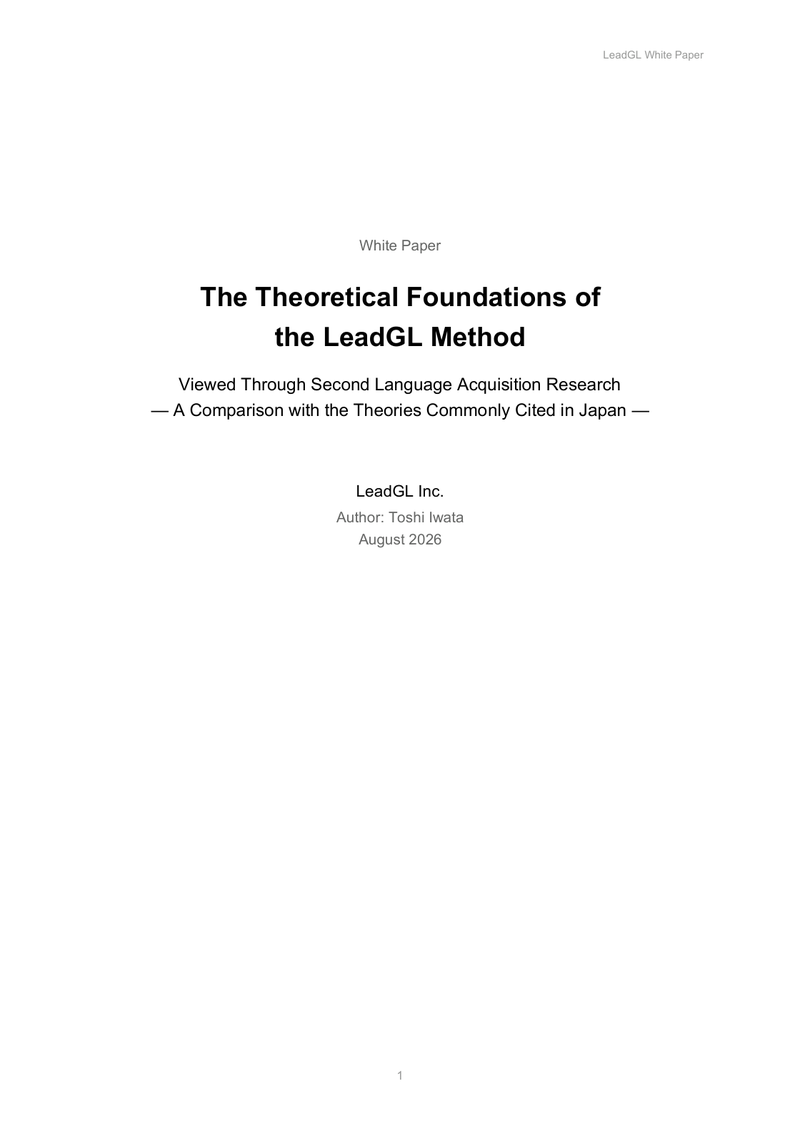
The Theoretical Foundations of the LeadGL Method
Viewed Through Second Language Acquisition Research
— A Comparison with the Theories Commonly Cited in Japan —
An academic paper with full citations, for training managers who want to check the rigor and for anyone evaluating the method professionally.
- For
- Corporate training managers, and professional reviewers
- Format
- PDF, A4, 10 pages
- Contents
- Abstract, six sections, a seven-dimension comparison table, 24 references
See a LeadGL program up close
We will walk you through the method and show you what a program actually looks like.