
WHITE PAPER / academic edition
The Theoretical Foundations of the LeadGL Method
Viewed Through Second Language Acquisition Research
— A Comparison with the Theories Commonly Cited in Japan —
In Japan, “second language acquisition theory” usually means something different from what the field now regards as best supported. The gap is not simply out-of-date information; the newer work is barely known here at all. This paper sets out that gap, and the theoretical foundations of the LeadGL Method.
Abstract
In Japan, the term “second language acquisition theory” most often refers to Krashen’s Monitor Model, and in particular to its Input Hypothesis — the “i+1” idea, popularly understood as “listen enough and you will be able to speak.” That understanding is a simplification of a theory formulated in the 1980s. Forty years of empirical research since have identified factors the original hypothesis does not adequately account for: the role that output (speaking and writing) plays, and the psycholinguistic mechanisms by which learners process input.
This paper shows that the English coaching method offered by LeadGL Inc. (the LeadGL Method) is built by integrating several bodies of empirical research that reflect these developments: second language acquisition theory, project-based learning, deliberate practice, the neuroscience of language, and research on the design of learning content. The method is designed for Japanese professionals and for the organizations they work in, whether Japanese companies or the Japan operations of foreign multinationals. The paper then sets out where the method differs structurally from the understanding of second language acquisition theory that prevails in Japan.
Keywords: second language acquisition, input processing theory, output hypothesis, project-based learning, deliberate practice, neuroscience of language
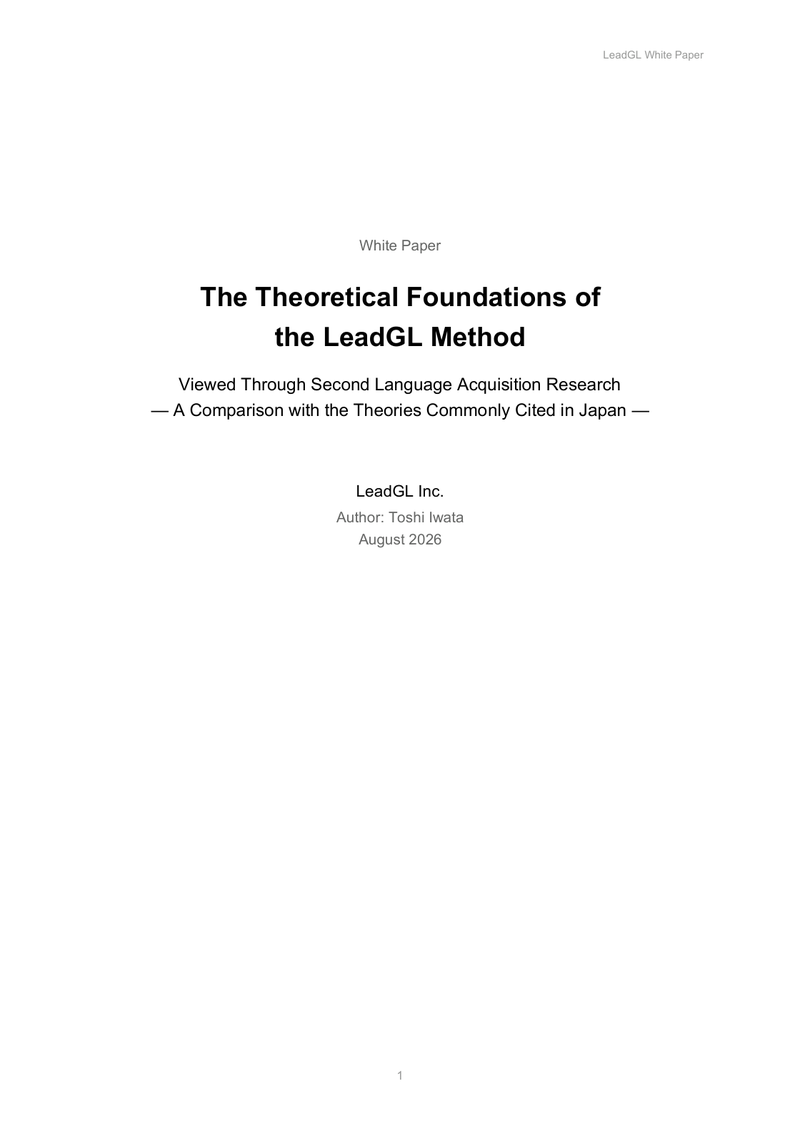
- Title
- The Theoretical Foundations of the LeadGL Method Viewed Through Second Language Acquisition Research
— A Comparison with the Theories Commonly Cited in Japan — - Author
- Toshi Iwata (LeadGL Inc.)
- Published
- August 2026
- Format
- PDF, A4, 10 pages
- References
- 24 (Krashen, Swain, VanPatten, Ericsson, Li & Jeong and others)
The Theoretical Foundations of the LeadGL Method
Viewed Through Second Language Acquisition Research
We will send the white paper (PDF, A4, 10 pages, 24 references) free of charge. The button below takes you to the request form, with the title of this paper already filled into the “Other questions” field.
This is not an instant download. Someone on our team reads each request and emails the paper to the address you give us.
You might also want
See a LeadGL program up close
We will walk you through the method and show you what a program actually looks like.